In short
You've found a sport you genuinely love. Padel is sociable, fast and properly addictive; one game a week quickly becomes three. Then, one morning, you pick up the kettle and feel a sharp twinge on the outside of your elbow. A few days later it's there when you shake hands, open a jar or grip the steering wheel. Welcome to padel elbow.
It's one of the most common complaints among the thousands of people who have taken up padel across the UK in the last few years, and it catches a lot of players by surprise. The good news is that padel elbow responds well to the right treatment, and most players get back on court without needing to give up the game they enjoy.
This guide explains what padel elbow is, why padel players are so prone to it, how to ease the pain, the exercises that help most and when to see a physiotherapist. Our physios treat racket-sport injuries as part of our sports injury physiotherapy at home service, so everything here comes from what we see in real players.
What is padel elbow?
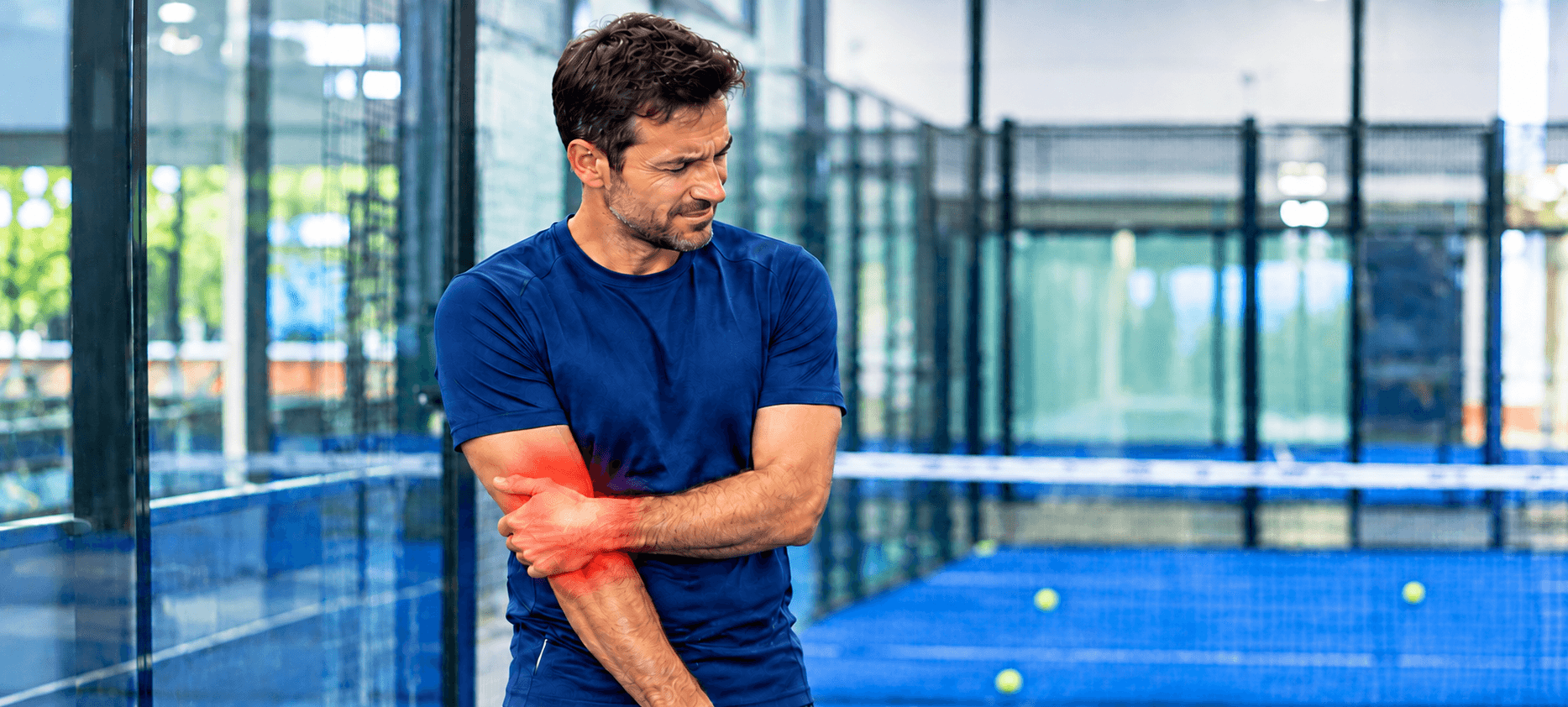
Padel elbow is the name players use for pain on the outside of the elbow caused by playing padel. Medically, it's the same condition as tennis elbow, known as lateral epicondylitis or lateral elbow tendinopathy. The NHS describes tennis elbow as pain around the outside of the elbow that often follows overuse of the forearm muscles.
Those muscles run from the outside of your elbow down to your wrist and fingers. Every time you grip the racket, stabilise your wrist or flick the ball back over the net, they pull on a small patch of tendon at the elbow. Ask that tendon to do more than it's ready for, week after week, and it becomes irritated and sore.
It isn't usually an injury from one bad shot. Padel elbow tends to build up gradually, which is exactly why so many players keep playing through it until it's properly painful.
Why padel players get elbow pain
Padel looks gentle compared with tennis, but several things about the game put the forearm under steady strain.
- A solid, heavier racket. Padel rackets have no strings. They're made of a foam core and a hard face, and they're usually heavier than a tennis racket at the head. More of the impact travels straight up through your wrist and into the elbow tendon, especially on off-centre hits.
- Lots of wrist-heavy shots. Volleys, blocks at the net, bandejas and viboras all rely on a firm wrist. Many newer players "flick" the ball with the wrist instead of using the shoulder and body, which loads the forearm muscles over and over.
- Gripping too tight. When rallies get quick, most of us squeeze the handle harder without realising. A tight grip keeps the forearm muscles switched on for the whole point, and that constant tension adds up.
- Too much, too soon. This is the big one. Padel is so much fun that people go from occasional games to four or five sessions a week almost overnight. Tendons adapt more slowly than enthusiasm does, and padel elbow is often the result.
- Age and everyday load. Elbow tendon problems are most common between about 35 and 55, which is also a prime age group for padel. If your job involves a lot of typing, mouse use, lifting or tools, your forearm may already be working hard before you step on court.
Symptoms of padel elbow
The signs usually creep in over a few weeks. Common symptoms include:
- Pain or tenderness on the bony bump on the outside of the elbow
- Pain that spreads down the forearm towards the wrist
- Discomfort when gripping, lifting, shaking hands or turning a door handle
- Pain on backhands, volleys or overheads during play
- Stiffness or an ache first thing in the morning
- A weaker grip, such as struggling to hold a full mug or open a jar
- If your pain is on the inside of the elbow instead, it may be golfer's elbow, which affects a different group of tendons. A physio can quickly tell the two apart.
UK Physio Tip: When to seek medical advice: if your elbow is very swollen, hot or red, you can't straighten or bend it, you have numbness or tingling in your hand, or the pain started after a fall or a heavy knock, see your GP or visit an urgent treatment centre rather than self-managing.
How to treat padel elbow at home
For most players, padel elbow settles with a sensible mix of load management and the right exercises. Complete rest is rarely the answer, because tendons need some load to heal properly.
- Adjust, don't abandon. Cut back on how often and how hard you play rather than stopping altogether. A useful guide is that pain during or after activity should stay mild, roughly 3 out of 10 or less, and settle by the next morning. If it's worse the following day, you've done too much.
- Ease the everyday strain. Lift things with your palm facing up, use both hands for heavier items and take regular breaks from typing or using a mouse. These small changes give the tendon a chance to calm down.
- Ice or heat. A wrapped ice pack on the sore spot for 10 to 15 minutes can help after playing. Some people find warmth more soothing for morning stiffness. Use whichever feels better.
- Try a forearm strap. An elbow support or counterforce brace worn just below the elbow can reduce the strain on the tendon during play. It won't fix padel elbow on its own, but it can make activity more comfortable while you rehab.
- Pain relief. Over-the-counter painkillers or an anti-inflammatory gel may help in the short term. Check with your pharmacist if you're unsure what's suitable for you.
Best exercises for padel elbow
Strengthening is at the heart of recovering from padel elbow. The Chartered Society of Physiotherapy's tennis elbow leaflet is a helpful starting point, and a physio can tailor the exercises to your stage of recovery. Here are four that players often begin with:
- Isometric wrist holds: rest your forearm on a table, palm down. Push the back of your hand up into your other hand without moving, and hold for 30 to 45 seconds. Repeat 4 to 5 times. This often eases pain quickly.
- Slow wrist extensions: holding a light weight or a water bottle, palm down, lift the wrist up and then lower it slowly for a count of three. Do 3 sets of 10 to 15.
- Grip squeezes: squeeze a soft ball or rolled-up towel for a few seconds and let go. Do 2 to 3 sets of 10 to 15.
- Forearm stretch: with your arm straight and palm down, gently bend the wrist down using your other hand until you feel a stretch along the top of the forearm. Hold for 20 to 30 seconds.
- Go steadily and increase the weight gradually over several weeks. Mild discomfort is fine; sharp or rising pain means it's time to ease back. Strong shoulders and upper back matter too, because they take load away from the forearm. Our shoulder pain physiotherapy team often works on both together.
How to prevent padel elbow
- Check your racket: a lighter, more evenly balanced or softer-core racket can reduce strain. Make sure the grip size suits your hand.
- Don't hold the racket too tightly: hold it firmly enough to be in control, and let the grip relax between shots.
- Use your body: let your legs, hips and shoulder drive the shot instead of flicking with the wrist. A coach can help here.
- Build up gradually: add extra sessions slowly rather than doubling your playing time overnight.
- Warm up properly: a few minutes of arm circles, wrist movements and easy rallying makes a real difference.
- Keep your forearm strong: carry on with your wrist exercises a couple of times a week, even after the pain has gone.
When should you see a physiotherapist?
If your padel elbow hasn't improved after two to three weeks of sensible self-care, it keeps coming back, or it's affecting work and everyday tasks, it's worth getting a proper assessment. Tendon problems tend to linger when they're left alone, and tennis elbow can take months to settle fully.
A physiotherapist will confirm the diagnosis, check your neck, shoulder and grip strength, and build a step-by-step plan that matches your game. That usually means a progressive strengthening programme, hands-on treatment to ease pain, advice on your racket and technique and a clear return-to-play plan, so you know exactly when you can step back on court. Find out more about physiotherapy at home and how it works.
Why home physio suits padel players
Most padel players are fitting games around work, family and everything else. With home visit physiotherapy, your physio comes to you at a time that suits you, with early mornings, evenings and weekends available where physios have the slots, so there's no travel and no waiting room.
Your physio can also set you up with exercises using what you already have at home, which makes it much easier to keep going between sessions. If you'd prefer to be seen locally, you can browse physiotherapy near me to find an HCPC-registered physio in your area.
Why players choose FlexAura Home Physio UK
FlexAura connects you with more than 230 HCPC-registered physiotherapists across the UK, including sports physiotherapists. Every physio on the platform is HCPC-registered, enhanced DBS-checked and insured, and their qualifications are reviewed before they join. Many can offer same-day or next-day appointments, subject to availability in your area.
We cover cities including London, Manchester, Birmingham, Leeds, Bristol, Liverpool, Edinburgh and Glasgow, or you can search by postcode. Prices are published upfront: a first home visit is £110, follow-ups are £99, a five-visit home package is £450 (£90 a visit) and a 30-minute online consultation is £45. You pay after the visit, there are no cancellation fees and no GP referral is needed. See the pricing page for the full breakdown. If you plan to claim through private health insurance, check with your insurer first; your invoice shows the physiotherapist's HCPC number.
Frequently asked questions
Is padel elbow the same as tennis elbow?
Yes. Padel elbow is simply tennis elbow caused by playing padel. The same tendon is affected and the treatment is very similar.
How long does padel elbow take to heal?
Mild cases can settle in a few weeks with the right changes. Longer-standing padel elbow can take a few months, which is why starting a strengthening plan early helps.
Can I keep playing padel with elbow pain?
Often, yes, at a reduced level. If pain stays mild during play and settles by the next day, carrying on is usually fine. If it's getting worse, take a short break and get it assessed.
Will a new racket fix padel elbow?
A softer or lighter racket can help reduce strain, but it's rarely enough on its own. Strengthening the forearm and improving technique are what make the biggest difference.
Get back on court without the pain
Padel elbow is frustrating, but it's very treatable. With the right exercises, a few changes to how and how often you play and some expert guidance, most players get back to full rallies and stay there.
Book a sports physiotherapist today or call 07782 610 633 to chat with our team about your elbow.
This article is for general information and is not a substitute for personalised medical advice. If you are worried about your symptoms, speak to your GP or a qualified physiotherapist.
Need Professional Help?
Find a verified, DBS-checked physiotherapist near you and book a home visit or online consultation.
Book Now