Note: This article is general information, not medical advice. Always follow the plan from your hospital team, GP or physiotherapist.
Introduction:
Physiotherapy after hospital discharge helps you recover your strength, balance, and the self-esteem taken from you. The first six weeks are crucial in this process. Start with gentle exercises in bed/chair right away, walk small but frequent distances, be sure your home environment is safe and check as soon as you have any issues with movement.
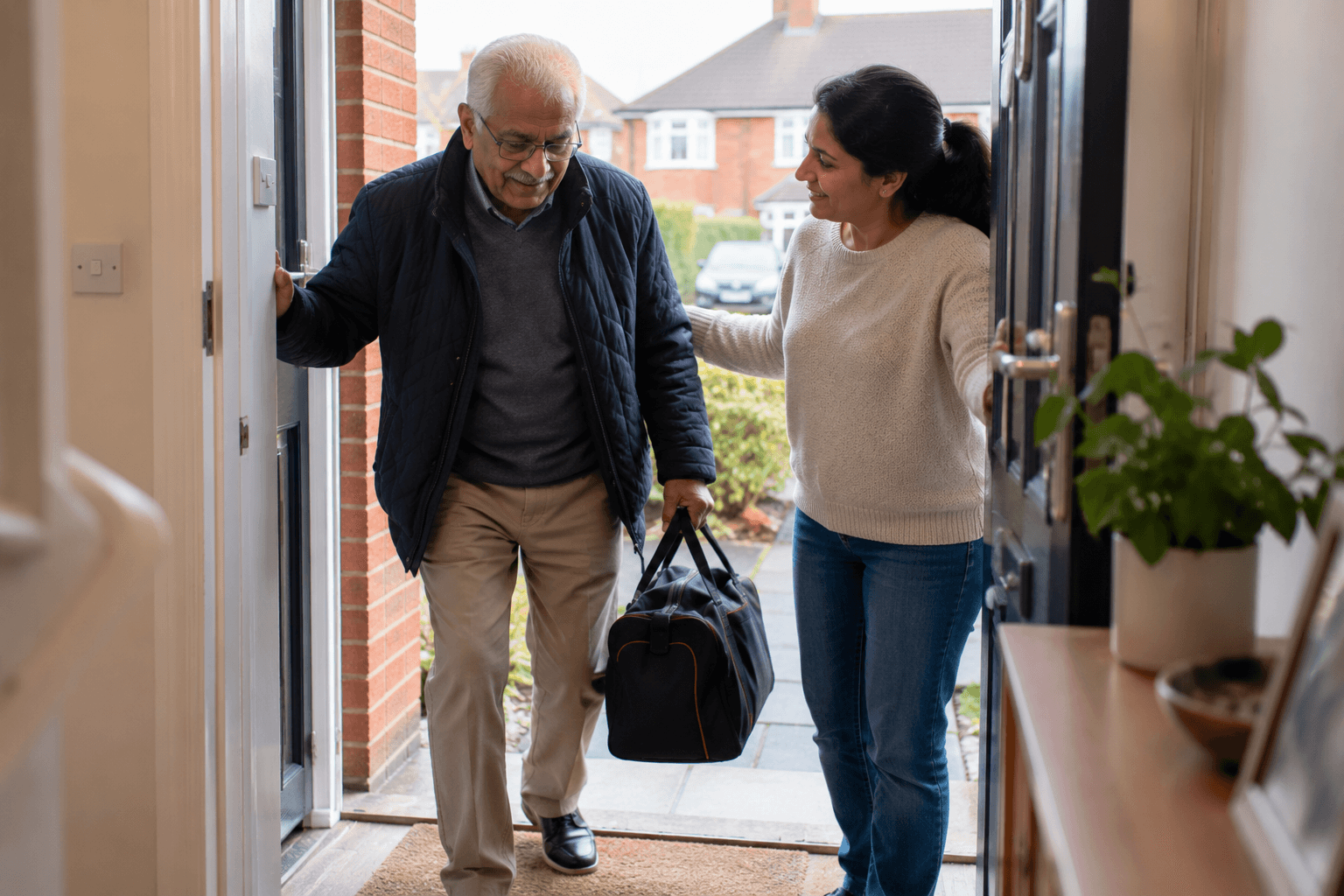
Returning home after being hospitalized is often surprising. Many people experience weakness legs, as well as the hard time climbing stairs or walking to the kitchen. However, these challenges can be clearly overcome after some time with the correct plan
What is physiotherapy after hospital discharge?
Physiotherapy after discharge from the hospital consists of special rehabilitation procedures aimed at returning mobility and independence to those who have been hospitalized. In fact, physiotherapy after hospital discharge is beneficial for:
- older patients whose strength has gone after being in bed for a long time
- different surgery patients such as hip or knee replacements
- people recovering after an illness, e.g. pneumonia
- patients with an unsteadiness feeling.
Physical therapists are healthcare professionals who specialize in rehabilitation, exercise, and movements. If you’re in the UK, all physiotherapists need to register with the Health Care Professions Council (HCPC).
The assistance after leaving hospital can come from either an NHS community team or private physiotherapist. With home visit physiotherapy, physiotherapy provides a major advantage due to the fact that the physiotherapist comes to your own home so that you can practice with everyday, everyday equipment like indoor steps and chairs. FlexAura physiotherapists visit all homes across the UK.
Why hospital stays leave you weaker
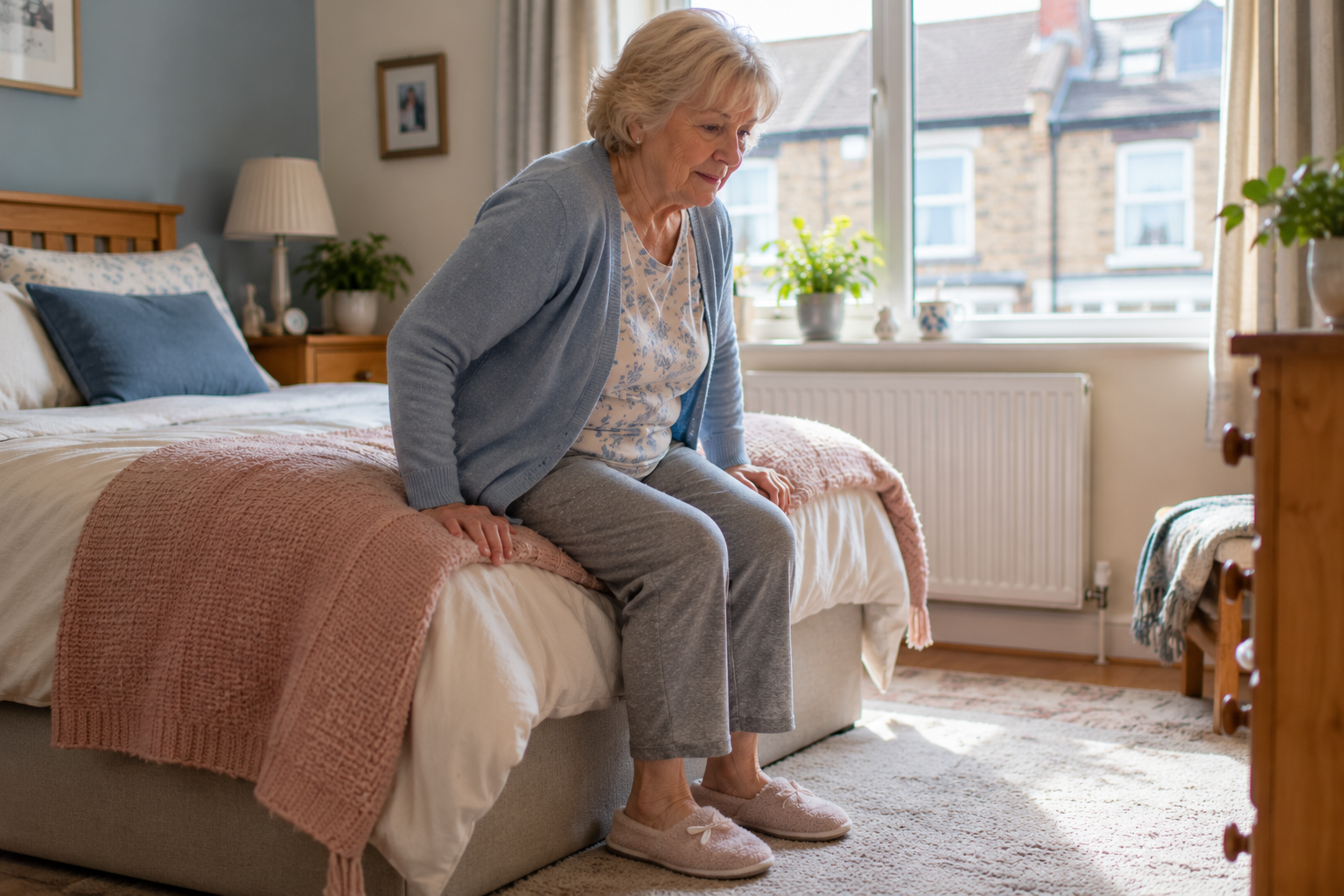
Staying in bed results in athletes becoming weaker. Physical therapy operates by treating them before they lose their strength and physical fitness.
Did you know? NHS England reports that “Many frail older people spend up to 83% of their inpatient time in bed and a further 12% in a chair.” It also notes that “muscle wasting starts within 24/48 hours of hospital admission.” Source: NHS England, #EndPJParalysis, 2018.
This is why the NHS ran the #EndPJParalysis campaign, which encourages patients to get up, get dressed and keep moving while in hospital. The sooner you move, the less ground you have to make up.
If you want to understand this in more depth, read our guide on why older adults lose strength in hospital.
Time spent in bed vs chair in hospital
[Chart: Horizontal bar chart titled “Where frail older patients spend inpatient time”. Bars: In bed 83%, In a chair 12%. X-axis 0-100%. Source label: NHS England, #EndPJParalysis, 2018.]
The takeaway is simple: most of a hospital stay is spent lying down, so most people come home needing to rebuild strength step by step.
Your discharge: what the NHS should arrange
Knowing what to do after hospital discharge starts before you leave the ward. Your team should plan your discharge with you and your family. Here is what to expect and ask about:
- A discharge letter. This sums up why you were admitted, what treatment you had and what happens next. A copy goes to your GP.
- Your medicines. Make sure you know what each one is for, when to take it, and whether anything has changed.
- Discharge to assess (D2A). Under D2A, the NHS assesses your longer-term needs once you are home, not on the ward. It aims to get you home sooner.
- Intermediate care and reablement. Reablement is short-term help at home from trained staff to relearn daily tasks, like washing and making a drink. Age UK explains: “If staff believe you have potential to achieve jointly agreed goals, this support is free for up to six weeks.”
- Community physio or occupational therapist referral. An occupational therapist (OT) looks at daily tasks and may suggest equipment, such as a raised toilet seat.
- GP follow-up. Check whether you need blood tests, a wound check or a review.
Ask for a phone number to call if things go wrong.
Week-by-week rehab plan for the first 6 weeks
Every recovery is different. This table is a starting point for rehab after hospital discharge, not a fixed timetable. Your physio will adjust it to suit you.
|
Week |
Main goal |
Example exercises |
Who can help |
Warning signs |
|
1 |
Get moving safely, avoid long spells in bed |
Ankle pumps, knee squeezes, sit-to-stand, short indoor walks |
Family, reablement team, physio |
Dizziness on standing, new breathlessness |
|
2 |
Walk further indoors, sit out for meals |
Seated marching, heel raises at the worktop |
Physio, OT |
Calf pain or swelling |
|
3 |
Practise stairs and getting in and out of bed |
Step-ups on the bottom stair with a rail |
Physio |
Pain that gets worse each day |
|
4 |
Build stamina, short walk outside |
Longer walks, balance holds at the worktop |
Physio, family |
Falls or near-falls |
|
5 |
Return to daily tasks |
Carrying light items, reaching, bending with support |
Physio, OT |
Fatigue that does not ease with rest |
|
6 |
Review goals and plan next steps |
Progress reps and walking distance |
Physio, GP |
Not improving, or going backwards |
Week 1: bed and chair exercises
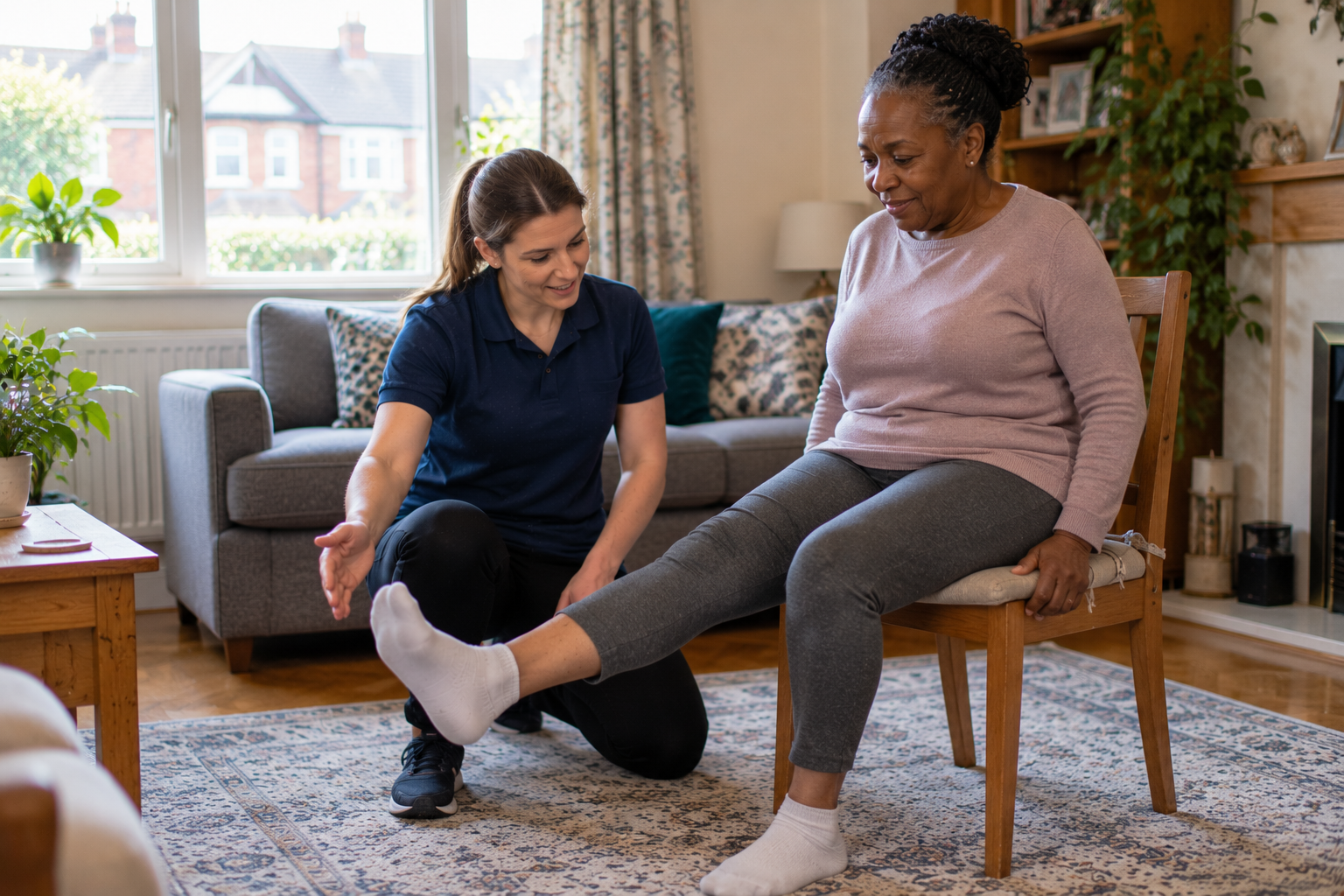
In a first home visit, the physio will usually watch you get out of bed, stand from a chair and walk a few steps. Then they set a short list of moves like these. Do them two or three times a day, with someone nearby if you feel unsteady.
- Ankle pumps. Lying or sitting, point your toes away, then pull them towards you. Repeat 10 times.
- Knee squeezes. Lying with legs straight, press the back of your knee into the bed and hold for 5 seconds. Repeat 10 times.
- Heel slides. Lying down, slide one heel towards your bottom, then slide it back. Repeat 10 times each leg.
- Sit-to-stand. From a sturdy chair with arms, lean forward, push up through your legs and stand. Sit back down slowly. Start with 5.
- Seated marching. Sitting tall, lift one knee, then the other, for 30 seconds.
These are good exercises for the first week home from hospital. For more ideas, see our bed exercises guide and tips on how to get up from a chair safely.
Weeks 2-6: walking, stairs and balance
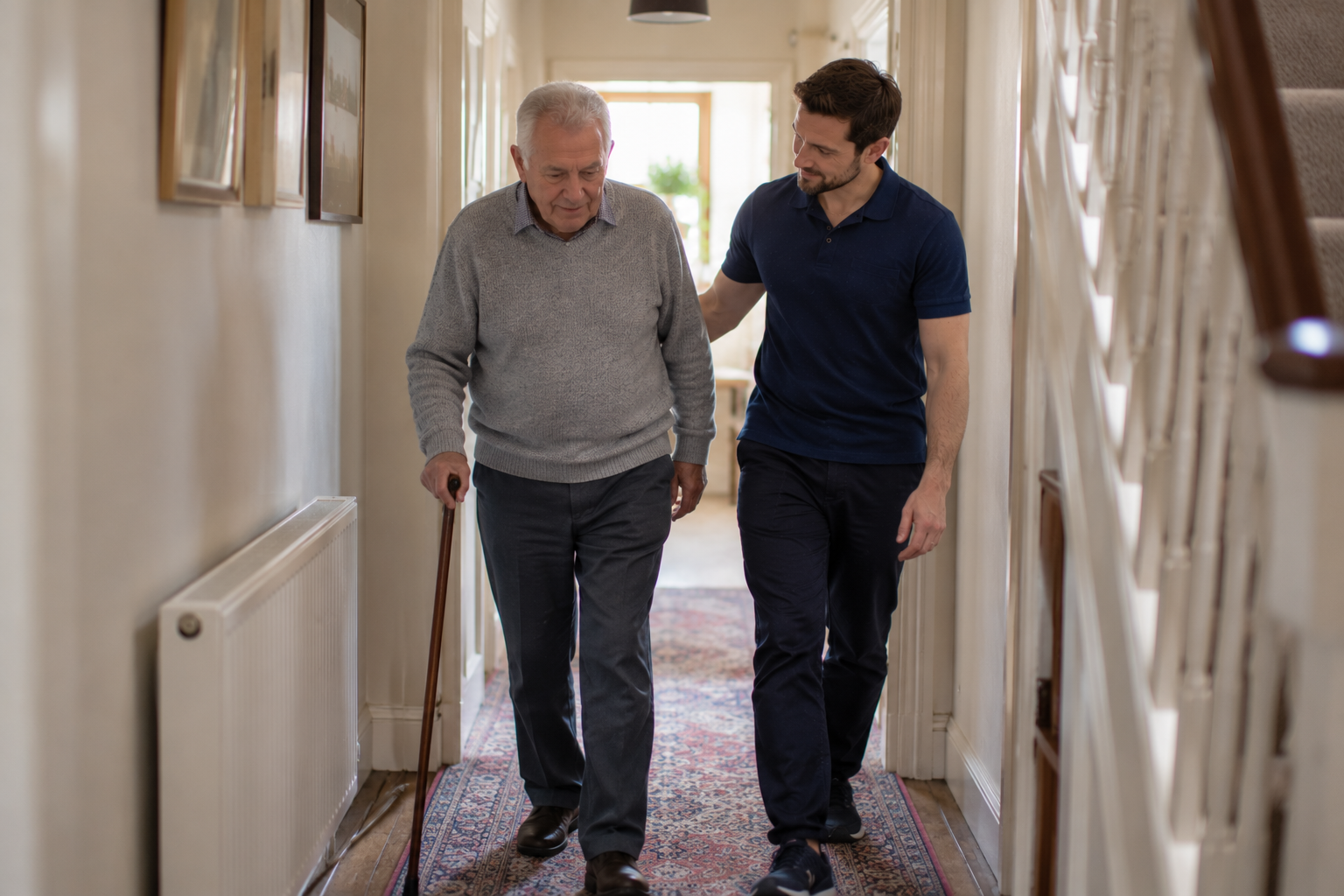
Once the basics feel easier, start to build. Little and often works better than one big effort.
- Indoor walking circuits. Walk from the lounge to the kitchen and back. Add one lap every couple of days.
- Stair practice. Hold the rail, step up with your stronger leg, and step down with the weaker leg first. “Up with the good, down with the bad” is an easy way to remember it.
- Balance at the worktop. Hold the kitchen worktop and stand with feet together for 10 seconds. Then try one hand only.
For more ideas using a chair, wall and towel, see our physio exercises you can do without equipment.
How long does rehab take after hospital discharge? It varies. A short stay for a minor problem may need a few weeks. A long stay or a serious illness can take months. Rebuilding strength usually takes longer than losing it, so be patient with yourself.
Get assessed at home
Moving feels harder than before you went in? An HCPC-registered, DBS-checked FlexAura physio can visit you at home. First visit £110 (60 min), pay after the visit, no GP referral needed. Book a home assessment.
Making home safe for recovery
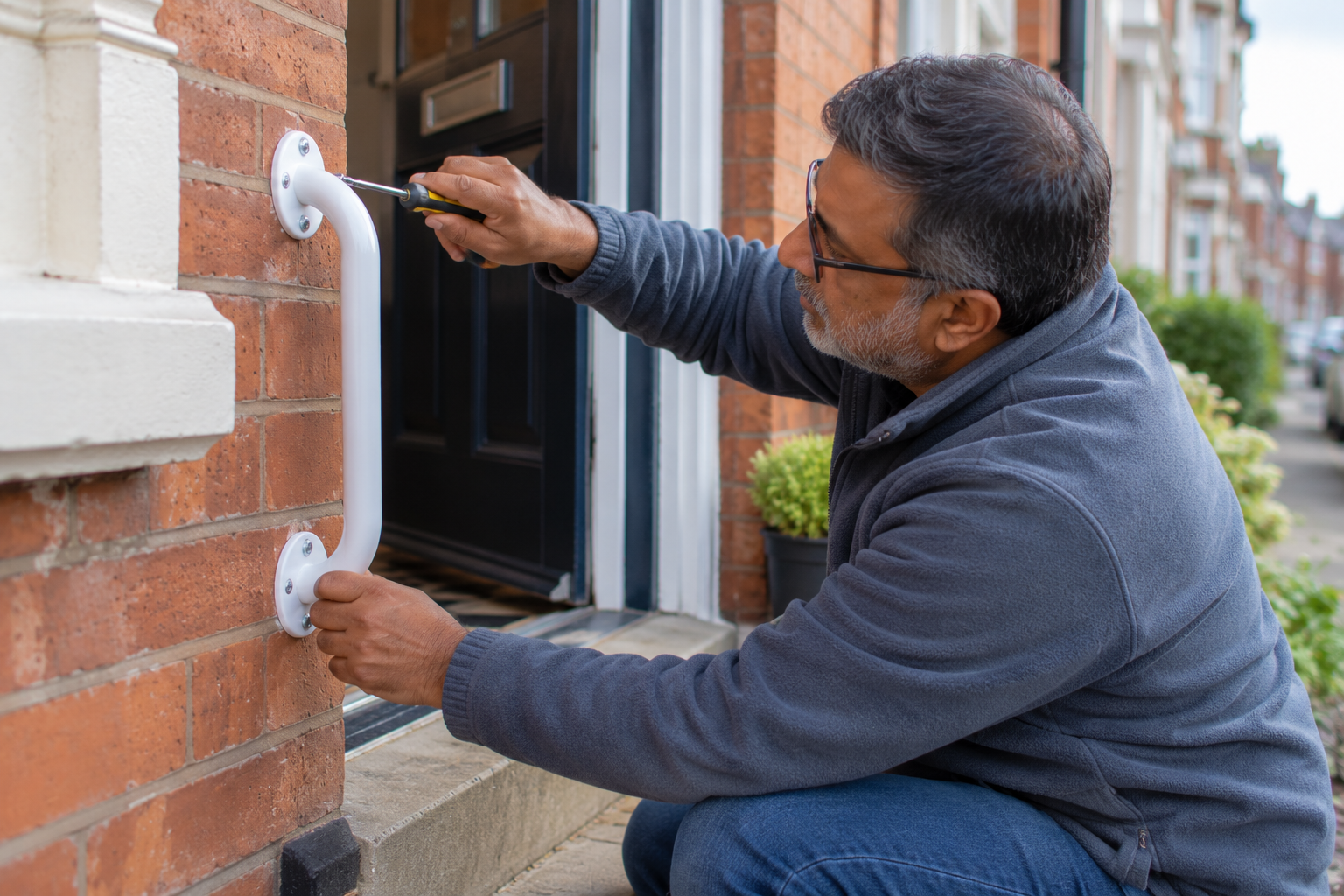
Falls risk is higher in the weeks after a hospital stay. Simple changes can help a lot. Use this checklist before or soon after you come home:
- ☐ Clear walkways of rugs, cables and clutter
- ☐ Put night lights in the bedroom, hallway and bathroom
- ☐ Check chair height: your hips should sit level with or just above your knees
- ☐ Fit grab rails by the toilet, bath and front step if needed
- ☐ Have a phone or alarm within reach at all times
- ☐ Ask about mobility aids, such as a walking stick or frame, if you feel unsteady
An OT or physio can advise on what equipment you need. Families can use our home-from-hospital checklist for families to plan ahead, and our guide to equipment after hospital discharge.
Recovering after surgery vs after illness
Rehabilitation after hospital discharge looks a bit different depending on why you were admitted.
|
|
After surgery (e.g. knee or hip) |
After illness (e.g. pneumonia, infection) |
|
Main problem |
Pain, swelling and stiffness around one joint |
General weakness and low stamina |
|
Focus of physio |
Range of movement, strength in the operated leg, walking pattern |
Whole-body strength, breathing, walking distance |
|
Typical precautions |
Follow surgical rules, such as hip precautions; protect the wound |
Pace yourself; watch breathing and heart rate |
If you are home after an operation, read about seeing a physiotherapist after surgery and our guide to recovering after surgery in Birmingham. We also offer post-surgery physio at home.
NHS community rehab vs private home physiotherapy
Both routes can work well.
|
|
NHS community rehab |
Private home visit (FlexAura) |
|
Referral needed |
Usually, from the hospital or GP |
No, you can book yourself |
|
Wait |
Varies by area |
Many physios have same-day or next-day slots, subject to availability |
|
Visit length |
Varies |
60 min first visit |
|
Cost |
Free (reablement free for up to six weeks if eligible) |
£110 first visit, £99 follow-up, £450 for 5 visits |
|
Choice of physio |
Assigned by the service |
You can choose |
Private physiotherapy at home after a hospital stay in the UK is an option, not a replacement for NHS care. To understand the visit itself, read what to expect from a home visit, or see our visit prices.
Red flags: when to seek urgent help
When to get urgent help - Call 999 or go to A&E for chest pain, sudden breathlessness, coughing up blood, signs of a stroke, or a fall with a head injury or a suspected broken bone. - Call NHS 111 or your GP the same day for a painful, swollen or warm calf (this can be a sign of a blood clot), new confusion, a fever, a wound that is red or leaking, or being unable to keep fluids down.
This list does not replace medical advice. If you are worried, ask for help.
Key takeaways
- Start gentle movement on day one at home. Muscle loss begins fast in hospital.
- Ask your team about D2A, reablement and community physio before you leave.
- Reablement may be free for up to six weeks if you are eligible.
- Build up walking, stairs and balance week by week, little and often.
- Make the home safe: clear floors, good lighting, rails and the right chair height.
- Physiotherapy after hospital discharge can be NHS, private or both.
Frequently asked questions
What happens after hospital discharge for elderly patients?
You leave with a discharge letter and your medicines, and your GP gets a copy. You may be referred for discharge to assess, reablement or community physio. Some people need a GP check within a week or two.
Is reablement free after hospital discharge in England?
Often, yes. Age UK says that if staff believe you can achieve agreed goals, intermediate care and reablement support is free for up to six weeks. If you face a wait for NHS help, private home physio is another option you can arrange yourself.
How soon should physiotherapy after hospital discharge start?
Ideally within the first few days. Gentle movement, such as ankle pumps and short walks, can start on day one at home. If you find moving harder than it was before you were admitted, book a physio assessment early, before you lose more strength.
What is reablement after hospital discharge?
Reablement is short-term support at home from trained staff. It helps you relearn daily tasks such as washing, dressing and making meals. It is usually arranged by your local council’s social care team. It works well alongside physiotherapy, which focuses on strength, balance and walking.
Can I get physio at home after a hospital stay?
Yes. NHS community teams may visit you at home after a referral. You can also book a private HCPC-registered physio. FlexAura physios visit homes in cities across the UK, including Birmingham and Leeds, with no GP referral needed. Online sessions are another choice.
How long does it take to recover after a hospital stay?
It depends on your age, your illness and how long you were in. Some people feel back to normal in a few weeks; others need several months. Rebuilding strength usually takes longer than losing it.
What exercises can I do in my first week home from hospital?
Start with bed and chair exercises: ankle pumps, knee squeezes, heel slides, seated marching and sit-to-stands. Add short indoor walks a few times a day. Stop and rest if you feel dizzy, very breathless or have sharp pain, and tell your physio or GP.
When should I call 999 after hospital discharge?
Call 999 for chest pain, sudden severe breathlessness, signs of a stroke, or a fall with a serious injury. For a painful swollen calf, new confusion or a fever, call NHS 111 or your GP the same day. If in doubt, ask for help early.
Conclusion: book a home physiotherapy visit
The first six weeks home set the pace for your recovery. Move early, build up slowly, and make your home safe. Physiotherapy after hospital discharge gives you a clear plan and someone to check you are on track. FlexAura physios are HCPC-registered, DBS-checked and insured, and visit homes across the UK, including home physio in Birmingham and physiotherapists visiting homes in Leeds. You pay after the visit, with no cancellation fee.
- Book a home visit: first visit £110 (60 min), follow-ups £99, or 5 visits for £450. Book now.
- Not sure yet? Try a 30-minute online consultation for £45, or WhatsApp us on 07782 610 633.
Sources
- NHS England, “#EndPJParalysis: the revolutionary movement helping frail older people” (2018): https://www.england.nhs.uk/2018/06/endpjparalysis-revolutionary-movement-helping-frail-older-people/
- Age UK, Factsheet 37: Hospital discharge and recovery (November 2025): https://www.ageuk.org.uk/documents/en-gb/factsheets/fs37_hospital_discharge_fcs.pdf
Need Professional Help?
Find a verified, DBS-checked physiotherapist near you and book a home visit or online consultation.
Book Now