Note: General information only, not medical advice. Agree your own goals with your physio or care team.
Quick answer: Good neuro physio goals are everyday activities you care about, such as walking to the shop, getting off the sofa or climbing your stairs. NICE says stroke rehab goals should be meaningful, focus on activity and participation, and be challenging but achievable. Seven practical areas cover most people with stroke, MS or Parkinson’s.
Book a neuro physio home visit: set your first goals at home, and pay after the visit.
What makes a good neuro physio goal?
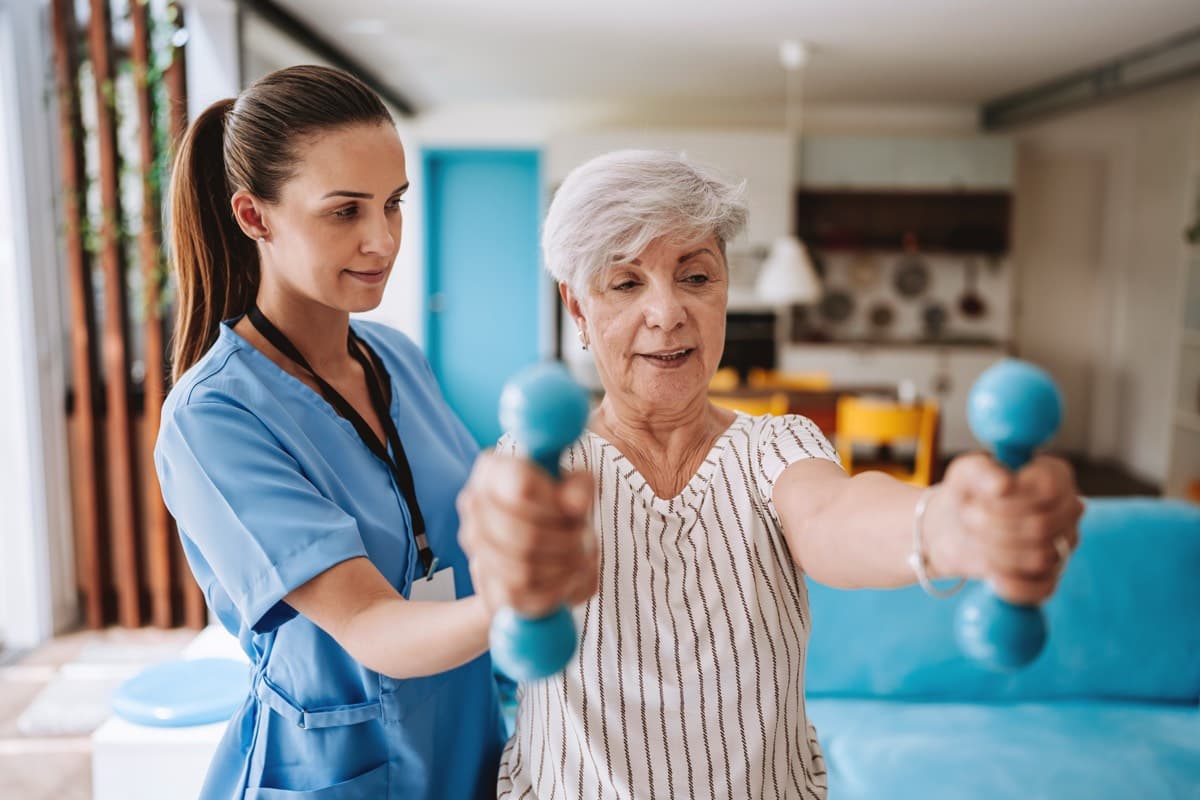
A neuro physio goal is a specific activity you and your physio agree to work towards, with a clear way to tell when you’ve got there. It should be in your own words.
NICE’s stroke rehabilitation guideline (NG236) says goals should:
- “are meaningful and relevant to them”
- “focus on activity and participation”
- “are challenging but achievable”
- “include both short- and long-term elements”
NICE also says to give people copies of their agreed goals and to review them at regular intervals. The NHS adds that getting family and friends involved can help (NHS).
|
Vague goal |
Practical goal |
|
“Walk better” |
Walk to the corner shop and back with a stick |
|
“Be more independent” |
Get in and out of the shower without help |
|
“Less tired” |
Shower and dress, then rest, without a crash later |
What are the 7 practical neuro physio goal areas?
Each row shows an example goal, how a neuro physio works on it, and what to practise between visits.
|
Goal area |
Example goal |
How a neuro physio works on it |
Practise between visits |
|
1. Walking |
Walk to the bus stop |
Walking training to build endurance and speed |
A short daily walk, adding a little distance |
|
2. Transfers |
Stand from a chair without pushing on the arms |
Repeated sit-to-stand practice |
Sit-to-stands during TV adverts |
|
3. Balance and falls |
Turn in the kitchen without grabbing the worktop |
Strength and balance training; how to get up after a fall |
Supported balance drills at the worktop |
|
4. Arm and hand use |
Lift a mug with the weaker hand |
Reaching, grasping and moving objects |
Daily tasks with the weaker hand |
|
5. Fatigue pacing |
Shower and dress, then still have energy for lunch |
Planning activity and rest |
A simple activity and energy diary |
|
6. Stairs |
Climb the stairs to bed safely |
Step practice with rails and supervision |
Agreed step drills, only with the support your physio set |
|
7. Getting outdoors |
Get to a café or a bus |
Gradual walks and outings |
One short outing a week |
What does the evidence say about each goal area?
The guidance supports this approach, though no one can promise results.
- Walking: NICE says to offer walking training to people after stroke who can walk, “to help them build endurance and move more quickly”.
- Transfers and stairs: NICE recommends repetitive task training for lower limb weakness, “such as sit-to-stand transfers, walking and using stairs”.
- Arm and hand: the same training covers reaching, grasping and moving objects.
- Balance and falls: Parkinson’s UK says a physio can teach “ways to help you get down safely on to the floor, and up again if you do fall” (Parkinson’s UK).
- Fatigue: the NHS lists advice about managing fatigue as MS support (NHS). Read about fatigue after stroke.
- Getting outdoors: NICE suggests community participation programmes, which can include “walking or using other means of transport, such as buses”.
How does a neuro physio adjust goals for stroke, MS and Parkinson’s?
The seven areas stay the same, but the focus shifts with each condition.
|
Condition |
What the source says |
How goals often change |
|
Stroke |
Recovery “can take months or years” for some people (NHS) |
Step-by-step goals, reviewed regularly |
|
MS |
Support may include “physiotherapy and exercises to help with movement problems and muscle pain” (NHS) |
Goals flex around fatigue and changing symptoms |
|
Parkinson’s |
See a specialist physio “as early as possible after you’ve been diagnosed” (Parkinson’s UK) |
Staying active; freezing and turning strategies |
Parkinson’s UK also says “Being active for 2.5 hours a week can help manage Parkinson’s symptoms”. For more, read Parkinson’s physiotherapy at home.
How do you track progress between neuro physio visits?
Keep it simple: one notebook, one goal at a time, and a review at each visit.
- Put the goal where you’ll see it, like the fridge.
- Note what you did each day, even bad days.
- Record time, distance or help needed.
- Tell your physio about new falls, pain or changes.
Want a plan built around your goals? A neuro physio can visit you at home and agree goals with you and your family. Book a home visit or WhatsApp 07782 610 633.
When not to book (get urgent help)
Rehabilitation can wait; emergencies can’t.
- Call 999 for signs of a stroke. The NHS uses FAST: “face, arms, speech and time to call 999” (NHS).
- Use NHS 111 if you’re unsure: “NHS 111 can help if you think you need medical help right now” (NHS).
- See your GP about new or worsening weakness, numbness or bladder changes.
How can you start working with a neuro physio in Edinburgh?
Start through the NHS, a clinic or a home visit; many people use more than one.
|
Route |
Cost |
Best for |
Bear in mind |
|
NHS physiotherapy |
Free |
Joined-up care with your NHS team |
The NHS says there “may be a long waiting list” |
|
FlexAura home visit |
£110 first, £99 follow-up |
Practising goals in your own home |
No specialist gym kit |
|
Private clinic |
Ask the clinic |
Equipment and classes |
Travel can be tiring |
|
FlexAura online video |
£45 for 30 minutes |
Reviewing goals and exercises |
No hands-on help |
Prices checked November 2026. Travel included; no cancellation fees.
- FlexAura covers all Edinburgh postcodes, including Morningside, Stockbridge, Leith, Corstorphine and Portobello, plus Musselburgh, Dalkeith and Livingston. See home physio in Edinburgh.
- For what neurological physiotherapy covers, visit the neuro physio service page.
- Full prices are on the pricing page.
Key takeaways
- Set goals around real activities.
- Seven areas cover most needs: walking, transfers, balance, arm and hand, fatigue, stairs and getting outdoors.
- Practise between visits and keep simple notes.
- Review goals regularly and change them as things change.
Frequently asked questions
What does a neuro physio do?
A neuro physio helps people whose movement has been affected by a condition of the brain, spinal cord or nerves. They:
- assess walking, balance and arm use
- agree goals with you
- teach exercises and safer ways to move
- show family how to help
They review and adjust the plan as you progress.
What are good neuro rehab goals?
Good goals are specific activities that matter to you, such as walking to the shop or getting upstairs to bed. NICE says stroke rehab goals should be meaningful, focus on activity and participation, be challenging but achievable, and include short- and long-term parts. Write them down and review them regularly.
Does neuro rehab work?
It can help, but results vary and nobody can guarantee an outcome. NICE recommends physiotherapy, walking training and repetitive task practice after stroke. The NHS says rehab exercises are “often difficult, but it will help you make progress”. Steady practice between visits usually matters as much as the sessions themselves.
What does neuro rehab involve?
Neuro rehab usually involves an assessment, agreed goals and regular practice. Depending on your needs, a team may include a physiotherapist, occupational therapist, speech and language therapist and nurse. Neuro physiotherapy focuses on movement: walking, balance, transfers, arm use and pacing. You’ll usually get exercises to do between sessions.
Can I have neuro physio at home?
Yes. The NHS says a physiotherapist may be able to visit you at home if you can’t get to your surgery or hospital. FlexAura physiotherapists also visit homes across the UK, including Edinburgh. A first 60-minute home visit costs £110, travel is included, and you pay after the visit.
Conclusion
The best neuro physio goals are small, specific and yours: a walk to the shop, a safe trip upstairs, a cup of tea made with your weaker hand. Practise between visits and review often. Slow progress is normal.
- Book a home visit: a neuro physio can set goals with you at home, from £110, paid after. Book now.
- Not sure yet? Try a 30-minute online consultation for £45, or WhatsApp 07782 610 633.
Sources
- FlexAura, Neurological physiotherapy, Pricing, Book and Edinburgh pages: https://www.flexauraphysio.co.uk/neurological-physiotherapy, /pricing, /book, /home-physio-edinburgh (accessed November 2026)
- NHS, “Recovering from a stroke”: https://www.nhs.uk/conditions/stroke/recovery/ (accessed November 2026)
- NHS, “Symptoms of a stroke”: https://www.nhs.uk/conditions/stroke/symptoms/ (accessed November 2026)
- NHS, “Multiple sclerosis: treatment”: https://www.nhs.uk/conditions/multiple-sclerosis/treatment/ (accessed November 2026)
Need Professional Help?
Find a verified, DBS-checked physiotherapist near you and book a home visit or online consultation.
Book Now